
By Isabel Fróes
Denmark has high ambitions for sustainable diets, while the path is clear, no one is taking the lead (yet).

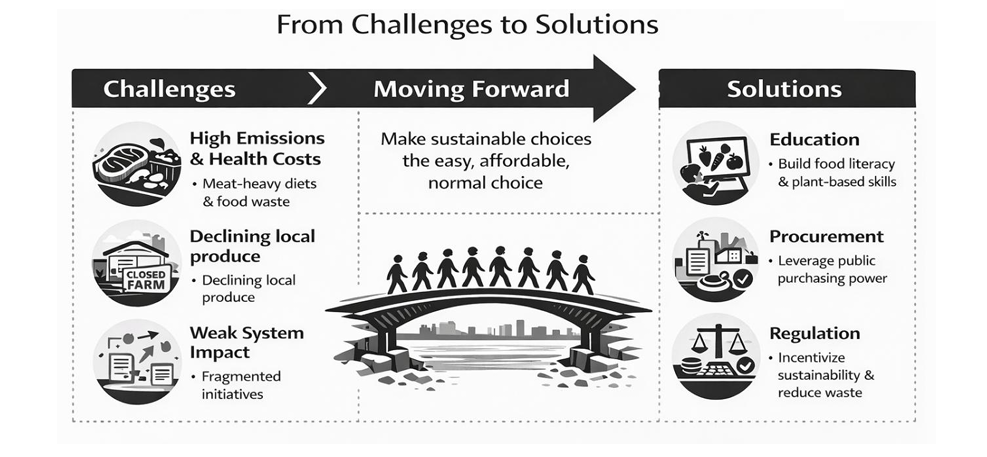
- Denmark’s food system is not making sustainable eating easy. Meat-heavy diets, high food waste, declining local fruit and vegetable production, and fragmented initiatives are slowing the shift to a more plant-based and sustainable food system.
- The costs are environmental, economic and social. Current food patterns increase emissions, weaken resilience, and worsen public health, while deeper import dependence leaves Denmark more exposed to future shocks.
- Implement a joined-up food strategy: build food skills, reform procurement, strengthen food-waste and sustainability rules, and redesign food environments so plant-rich, low-waste choices become the default.
Despite its gastronomy success, the New Nordic Cuisine manifesto1 and Danish households are miles apart in Danish food habits. Current urban food systems in Denmark face multiple crises, including environmental degradation, significant food waste, resource inefficiencies, and social inequalities2. As with its gastronomy, Denmark needs to challenge its status quo of food culture and consumption to achieve a more plant-based (aka vegetable-rich) and sustainable food system they strive for3.
In Europe, animal products generate 82% of diet-related greenhouse gas emissions, yet a strategic shift toward plant-based diets could reduce these emissions by up to 90%. Economically, the continued decline of Danish horticulture, which currently accounts for only 0.6% of land use, threatens local livelihoods and increases national vulnerability to global supply chain shocks. Collectively, these systemic inefficiencies exacerbate rising obesity rates and poor dietary adherence, placing an unsustainable long-term strain on the national healthcare system4.
Thorough analysis has demonstrated that despite the various initiatives across the value chain, these are not coordinated to engage with each other5. This lack of integration leads to “broken paths”, where the efficacy of the initiatives do not provide a common flow across the food system. Some of the outstanding issues that need to be tackled can be broken down into three key points: consumption patterns, systemic barriers and knowledge gaps.
First, there is an urgent need to shift diets toward lower-impact consumption, meaning moving away from ever-rising meat consumption toward diets with less meat overall (meat is still the star on Danish plates, present in 76% of Danish dinners and 58% of lunch meals6), a realistic social norm rather than an individual moral burden. This means reducing routine meat consumption while also tackling avoidable food waste through better portioning, clearer guidance, and practical prompts that help households and food-service providers use food more efficiently. Taken together, these changes can reduce the environmental footprint of diets without relying only on consumer goodwill, especially when supported by well-designed nudges and more visible sustainable alternatives.
Second, food environments often work against sustainable choices; the most visible, convenient, familiar, and socially reinforced options are not always the most sustainable ones. Retail settings, menus, promotions, and choice architecture can therefore lock consumers into unsustainable habits, even when awareness is high. The known “impulse shopping” is never towards green or plant-based options; just remember what is looking back at you when you are about to pay in supermarket lines, it is most certainly not a nice crunchy carrot.
Third, the lack of integrated food education and weak coordination across the food chain, from production and distribution to retail and final consumption. Consumers are often expected to make better choices without receiving consistent, practical, and trustworthy information, while producers, intermediaries, and public institutions are not always aligned around shared sustainability goals. Closing this gap requires joined-up initiatives that combine education, communication, and cross-chain collaboration so that knowledge is translated into action at every stage of the food system.
The chicken and egg situation
These issues are rooted in both ends of the system, from rigid legal and procurement frameworks, a lack of behavioural insights in policy design, to cultural norms and perceptions such as “meal compositions (meat in the centre)” as well as “freshness” that leads to premature discarding of food.
In one end, we have to deal with low “home” production and consequently, low resiliency. Between 2017 and 2023, Danish production of fruits and vegetables fell by 27%, leaving the country heavily reliant on imports; currently, 3 out of every 4 vegetables consumed in Denmark are imported7. At the same time, constrained procurement practices and concentrated supply structures in public catering make it difficult for SMEs and local producers to enter the market and compete fairly, limiting the role of Danish and seasonal produce in everyday food provision.
In the other end, Danish citizens are far from meeting the “6-a-day” vegetable recommendation, and while meat consumption has dipped slightly, Danes remain among the slowest in Europe to adopt plant-based diets. Thus, Danish diets still fall short of public health and sustainability goals. These patterns are reinforced by behavioural and cultural barriers, including strong attachment to meat and the perception that sustainable meals are costly, inconvenient, or difficult to prepare.
Such scenario is aggravated by practical and cultural deficits in food management across various stakeholders. Approximately one-third of global GHG emissions stem from the food system, with a significant portion attributed to avoidable food waste driven by confusing labelling, a lack of kitchen-management skills and declining knowledge of seasonal produce and food preparation. For example, school kitchen staff, which help shape long-term dietary habits, are not well-versed in cooking diverse vegetable-rich meals. While cooking education is present in the Danish school curricula, which puts Denmark further ahead compared to other European countries, it does not yet incorporate plant-based or waste aspects in its program. Together, these gaps make local and sustainable food options less attractive and contribute to avoidable waste.
Food matters: Here comes everybody
The failure to transition to a more sustainable food system carries severe implications across environmental, economic, and public health sectors. In Europe, animal products generate 82% of diet-related greenhouse gas emissions, yet a strategic shift toward plant-based diets could reduce these emissions by up to 90%. Economically, the continued decline of Danish horticulture, which currently accounts for only 0.6% of land use, threatens local livelihoods and increases national vulnerability to global supply chain shocks. Collectively, these systemic inefficiencies exacerbate rising obesity rates and poor dietary adherence, placing an unsustainable long-term strain on the national healthcare system.
From the wider social perspective, everyone pays a high bill if we continue “life as we know it” and perpetuate the status quo in food consumption. Therefore, we need to bring everyone on board. Civil society needs to be the primary target for interventions that can help the shift into more sustainable patterns. Authorities and industry stakeholders have a key role in procurement standards and the need for new skills; while education, laying the path for future generations, is essential to safeguard the environmental and social foundations required for future food security.
Failure to transition into more sustainable diets threatens long-term ecosystem stability and livelihoods. Conversely, a more circular and sustainable food system integrates efficiency with equity, fostering resilient and inclusive pathways for society.8
When there is the will, there is a way
Building a circular and sustainable food system requires tackling existing challenges as a starting point for transition. This calls for coordinated reforms and actions in education, communication, and legislation, implemented in parallel to achieve broad societal impact. For clarity and actionability, the proposed measures are grouped into thematic areas, each with defined purposes.
Capacity Building & Education
Building a more sustainability-oriented food culture requires a foundational shift in food literacy, starting from primary education and extending to professional culinary training. By integrating seasonal knowledge and practical cooking skills into curricula and vocational programs, we can empower both consumers and practitioners to master the plant-forward and waste-free techniques necessary for the transition.
- Integrate co-designed food education programs (with focus on vegetable-rich/plant-based food) into school curricula (e.g., the Danish Madkundskab) and vocational training for chefs, schools and canteen staff.
- Establish “holistic food schools” to train professionals in sustainable sourcing and food-waste reduction. This approach should include specialized training for professional chefs in public kitchens to master “plant-forward” cooking.
Procurement Reforms
Public procurement serves as a powerful strategic instrument for driving systemic change by leveraging institutional purchasing power to support sustainable and innovative food production. By decentralizing tenders and fostering direct partnerships with local small-scale producers, municipalities can rebuild regional resilience and overcome the market concentration that currently favours imported goods.
- Decentralize tenders: Reform public procurement frameworks to allow for “partial tenders,” enabling SMEs and local farmers to supply public kitchens directly.
- Establish dedicated procurement teams to prioritize seasonal, local, and organic produce. The City of Copenhagen’s model demonstrates that achieving 90% organic procurement is possible without increasing costs by reducing meat portions and food waste.
Legislative & Policy Shifts
A robust legal and fiscal framework is necessary to embed sustainability into the institutional core of the food system and ensure long-term accountability. Policies must transition from voluntary measures to mandatory monitoring while utilizing economic incentives to level the playing field for green production.
- Implement a robust legal framework requiring public kitchens and large-scale caterers to monitor and report food waste.
- Use tax incentives (e.g., the “Agreement on a Green Denmark”) to incentivize lower agricultural emissions and support a feasible regenerative agriculture transition where farmers are compensated and trained into new agricultural approaches.
- Introduce bans on advertising unhealthy foods (high in fat, sugar, and salt) near schools and playgrounds to shape sustainable habits from an early age.
Communication & Labelling
Sustainable consumption depends on redesigning the “choice architecture” of food environments to make plant-based and low-waste options the default, rather than an exception. Clearer communication and intuitive labelling are essential to remove the behavioural “sludges”, such as confusion over expiration dates that lead to significant avoidable food waste.
- Reform food labelling to include phrases like “best before, often good after” to encourage consumers to trust their senses and reduce waste.
- Launch cross-sectoral campaigns to normalize circular practices and reframe “expired” but safe food as a valuable resource.
- Implement “choice architecture” in public canteens, such as making plant-based meals the default and offering meat as an opt-in.
- In collaboration with the retail sector, develop nudge campaigns to help consumers transition to less meat-heavy diets through “once a week” labelling and campaigns.
The low-hanging fruit for policymakers
- Introduce bans on advertising unhealthy foods near schools and playgrounds.
- Launch cross-sectoral campaigns to normalize sustainable practices.
- Reform food labelling.
- Make plant-based the default in public canteens.
- Collaborate with the retail sector towards nudge campaigns for wider reach.
- Integrate plant-based/vegetable-rich food education programs into school curricula.
- Establish “holistic food schools” for kitchen chefs and school staff.
- Decentralize tenders.
- Implement sustainability-driven procurement.
- Use tax incentives to support regenerative agriculture transition.
As with any change, a transition to a more plant-driven and sustainable Danish food system will inevitably raise concerns: that such changes may limit consumer choice, increase costs for households and public institutions, or place additional pressure on farmers, retailers and food-service providers already operating under tight margins. These concerns should be taken seriously. But they are not arguments for inaction. Rather, they underline the need for a transition that is fair, gradual and well-supported. The point is not to moralise individual diets or impose unrealistic standards overnight; it is to redesign the system so that healthier, more sustainable choices become easier, more affordable and more normal for everyone involved.
To conclude, changes can be achieved but we need national and local authorities to take the lead in carrying out a systemic and well-structured redesign following a multi-level strategy, leveraging public procurement, behavioural nudges, and educational reform. These changes aim to restore local production resilience and shift consumer habits toward more sustainable and resilient food production and consumption. If successfully implemented, these actions could enable Denmark, much like its gastronomy, to offer a model with influence beyond its own borders, making every Danish table a success story for the Nordics and beyond.
- https://www.falstaff.com/en/news/how-new-nordic-changed-the-world-two-decades-of-a-culinary-revolution ↩︎
- Schebesta, H. (2024). The Member States in the EU Food System: National Regulatory Options for Sustainable Food Offer, Food Consumption and Food Environments. European Journal of Risk Regulation, 15(2), 292–309. https://doi.org/10.1017/err.2024.36 ↩︎
- https://fvm.dk/nyheder-og-pressemeddelelser/2021/mar/millioner-paa-vej-til-plantebaseret-kost ↩︎
- Burgaz, C. et al (2023). The effectiveness of food system policies to improve nutrition, nutrition-related inequalities and environmental sustainability: a scoping review. Food Security, 15(5), 1313–1344. https://doi.org/10.1007/s12571-023-01385-1 ↩︎
- Beacon research results, action cards: https://beaconproject.dk/wp-content/uploads/sites/43/2025/11/Discussion-cards-for-Stakeholders.pdf; ↩︎
- https://www.madkulturen.dk/wp-content/uploads/2023/06/Mere-dansk-frugt-og-groent-Analyserapport.pdf ↩︎
- https://www.madkulturen.dk/wp-content/uploads/2023/06/Mere-dansk-frugt-og-groent-Analyserapport.pdf ↩︎
- https://beaconproject.dk/wp-content/uploads/sites/43/2025/11/Roadmap-towards-a-Circular-Society_BEACON-Project.pdf ↩︎